

Posted on: 19 November 2026
Maritime London convened UK Day as part of Shanghai Pudong International Shipping Week 2026 at the Shanghai International Convention Center on 21 October. Bringing together maritime leaders, policymakers, financiers, legal experts and technology innovators from the UK and China, the one-day forum explored the major forces reshaping global shipping, including geopolitics, dispute resolution, digitalisation, decarbonisation and shipping finance. The programme concluded with a networking reception that provided delegates with an opportunity to continue discussions and strengthen business relationships. Visit HERE to view the agenda containing download links to speeches and presentations and the event’s photo HERE.
Opening the event, Mark Williams, CEO of Maritime London, underscored the importance of the UK-China maritime relationship and the role both nations play in supporting global trade. He highlighted London’s position as one of the world’s leading maritime professional and financial centres, with internationally recognised strengths in shipbroking, marine insurance, maritime law, arbitration and finance. He also noted that the wider UK maritime sector contributes approximately £63 billion annually to the economy and supports more than one million jobs.
Drawing on the latest Baltic Exchange-Xinhua Global Maritime Cluster Rankings, Williams observed that Shanghai and London are ranked second and third respectively, demonstrating the scale, influence and global reach of both maritime centres. He emphasised the complementary nature of the relationship, with China leading in shipbuilding, trade, ports and manufacturing, while the UK provides expertise in finance, insurance, legal services, research and regulation.
Williams also highlighted the UK’s growing leadership in maritime innovation and decarbonisation, citing advances in alternative fuels, vessel efficiency, route optimisation and digital technologies. Against a backdrop of geopolitical uncertainty and energy transition, he stressed that practical international cooperation would be essential to addressing the increasingly complex challenges facing the shipping industry.
Introducing the themes that would shape the day’s discussions, Williams identified geopolitical disruption, maritime dispute resolution, technological innovation, vessel efficiency and shipping finance as critical issues for the future of a resilient, efficient and sustainable maritime sector. He concluded by thanking the event’s partners, sponsors and speakers for their contributions to strengthening dialogue and collaboration between the UK and Chinese maritime communities.
Welcoming delegates on behalf of the UK Government, Colin Colas, Head of East China at the Department for Business, Innovation, Science & Trade (BIST), highlighted the strength of the UK-China maritime partnership at a time of rapid industry transformation. He pointed to significant opportunities for collaboration in green and smart shipping, while inviting delegates to continue the conversation at London International Shipping Week 2027.
A similar message was echoed by Dong Xiaoling, Deputy Director of the Shanghai Pudong Committee of Commerce, who welcomed participants to one of the flagship events of the expanded shipping week programme. Highlighting the complementary strengths of Shanghai and London, she emphasised opportunities for cooperation in maritime services, technology, innovation and decarbonisation, expressing confidence that deeper UK-China collaboration would contribute to the future development of the global maritime industry.
In a keynote address, John Denholm, Chairman of the International Chamber of Shipping and Chairman of J&J Denholm Ltd, focused on the importance of international cooperation in addressing the industry’s most pressing challenges. He argued that global trade depends on a stable, rules-based framework and cautioned against increasing regulatory fragmentation. Addressing geopolitical tensions, decarbonisation and investment requirements, he stressed the need to protect freedom of navigation, support seafarer safety and create the certainty required for investment in ships, fuels and infrastructure. The future of shipping, he concluded, would be shaped not by individual nations, but by their ability to work together.
Geopolitics, Trade and Maritime Risk
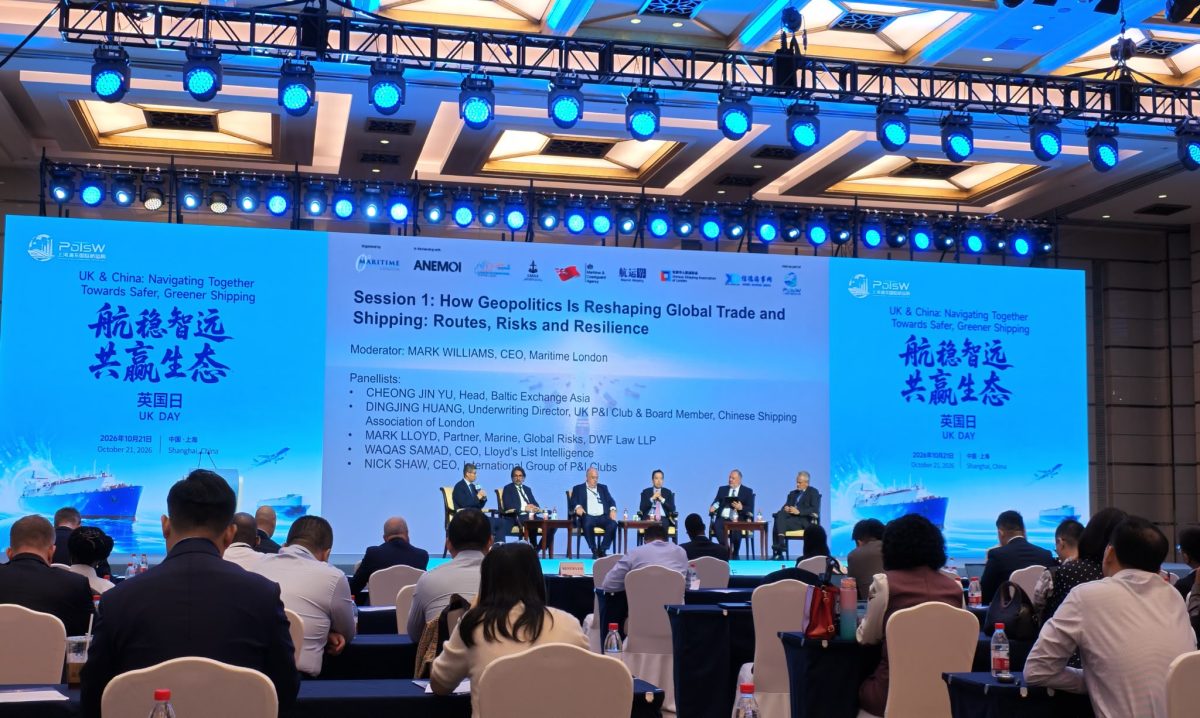
The first session examined the growing impact of geopolitical change on global trade flows, vessel deployment and maritime risk. Delegates heard from Sanshray Agarwal, Lead Data Scientist at London Stock Exchange Group, whose presentation demonstrated how geopolitical disruptions during 2026 reshaped global oil markets and shipping patterns. He showed that while increased exports from the United States partially offset disrupted Middle Eastern supply, importers across Asia increasingly turned to alternative sources in Brazil, Guyana and Argentina. China’s significant crude inventories also helped cushion the impact of supply disruptions. The analysis highlighted how pressure on key maritime chokepoints, including the Strait of Hormuz and Bab al-Mandeb, led to vessel rerouting, longer voyage times, changing fleet deployment patterns and increasing operational risks.
Building on these themes, a panel moderated by Mark Williams brought together Cheong Jin Yu of Baltic Exchange Asia, Dingjing Huang of the UK P&I Club, Mark Lloyd of DWF Law LLP, Waqas Samad of Lloyd’s List Intelligence, and Nick Shaw of the International Group of P&I Clubs. The discussion explored the implications of geopolitical tensions, regulatory change, cyber threats, climate risks and market volatility for global shipping. Panellists considered the resilience of supply chains, emerging trade patterns, maritime security risks and the importance of maintaining international cooperation in an increasingly fragmented world.
Maritime Arbitration and Dispute Resolution
Attention then turned to maritime dispute resolution, an area in which London continues to play a leading international role. A panel – featuring Clive Aston, former President of the London Maritime Arbitrators Association (LMAA); Dr Melis Özdel of UCL Faculty of Laws; Wenhao Han of Spencer West LLP; and Ian Gaunt, also a former President of the LMAA – examined the continued relevance of London arbitration for international shipping and the opportunities and challenges presented by AI.
Opening the session, Clive Aston outlined the development and enduring success of the LMAA. He highlighted the advantages of arbitration over court proceedings, including confidentiality, speed, cost-effectiveness and access to specialist maritime expertise. He noted that London remains the world’s leading centre for maritime arbitration, supported by English law, experienced arbitrators and strong judicial support.
Exploring the intersection of technology and law, Dr Melis Özdel argued that artificial intelligence is likely to become an increasingly important tool in maritime arbitration. While AI can enhance research, transcription, document management and issue identification, she stressed that legal judgement, credibility assessments and decision-making must remain firmly in human hands. Transparency, confidentiality and procedural fairness, she argued, will be essential as AI becomes more widely adopted across dispute-resolution processes.
Providing a practical perspective for Chinese users of London arbitration, Wenhao Han highlighted the importance of impartial arbitrators, comprehensive record keeping, effective witness preparation, and clear communication within the framework of English legal practice. These factors, he noted, can significantly influence the effectiveness of arbitration proceedings and their eventual outcome.
Concluding the session, Ian Gaunt challenged several common misconceptions about London arbitration among Chinese shipping companies. He emphasised that Chinese parties frequently achieve successful outcomes in London proceedings and argued that concerns over cost, cultural differences and procedural complexity can often be addressed through careful preparation, effective use of technology and high-quality interpretation services.
Innovation, Data and Digital Transformation
The afternoon programme featured a Technology Showcase session that focused on technology and innovation, reflecting the growing importance of data, analytics and digitalisation in modern shipping. Chaired by Graham Candy of the UK Shipping Concierge, the session featured speakers from Lloyd’s List Intelligence, Chelsea Technologies, London Stock Exchange Group and SpecTec to demonstrate how digital tools are enhancing operational efficiency, compliance and commercial decision-making.
Carter Yang, Head of Greater China at Lloyd’s List Intelligence, presented the company’s maritime intelligence and risk-management capabilities, demonstrating how vessel tracking, ownership analysis, sanctions screening and compliance tools can help organisations navigate an increasingly complex regulatory environment. Particular attention was given to the detection of AIS manipulation, concealed ownership structures and deceptive shipping practices.
Matteo Contu of Chelsea Technologies introduced FastBallast, a portable ballast-water monitoring system designed to provide direct verification of treatment performance. By enabling operators to assess biological compliance on board, the technology offers greater confidence in meeting IMO ballast-water requirements while supporting more effective operational decision-making.
Presenting on behalf of London Stock Exchange Group, Yaoyao Wang demonstrated how shipping data, commodity intelligence and news analytics can be combined to identify emerging market developments before they become visible through pricing signals. Drawing on examples from the Red Sea and Strait of Hormuz, she illustrated how organisations can build an evidence-based understanding of geopolitical disruption and its impact on supply chains.
The session concluded with a presentation from Steve Yeoh of SpecTec, who outlined how the company’s AMOS platform is helping shipowners modernise fleet operations through integrated asset management, maintenance, procurement and compliance systems. He also highlighted emerging AI-enabled capabilities designed to streamline procurement and strengthen operational decision-making while maintaining robust governance and audit controls.
The Technology Showcase session reinforced a recurring theme throughout UK Day: that data, digital intelligence and trusted information are rapidly becoming essential tools for safer, more efficient and more resilient shipping operations.
Decarbonisation and Vessel Efficiency
The following Efficient Ship session focused on decarbonisation and one of the industry’s most pressing questions: how shipping can reduce emissions today while preparing for the longer-term transition to alternative fuels. Moderated by Wong Kai Cheong of INTERTANKO, the session opened with a keynote address from Deborah Owens, Deputy Director for Maritime Environment and Decarbonisation at the UK Department for Transport.
Owens argued that maritime decarbonisation cannot rely solely on future fuels. While alternative fuel development remains essential, she stressed that the industry must also pursue immediate emissions reductions through proven efficiency measures. Drawing on examples ranging from advanced hull designs and wind-assisted propulsion to voyage optimisation, predictive maintenance and artificial intelligence, she highlighted the role that technology, data and operational improvements can play in reducing fuel consumption and emissions today. She also outlined the UK’s commitment to maritime decarbonisation through initiatives including the UK Maritime Decarbonisation Strategy and the UK SHORE programme, emphasising the importance of innovation, skills development and international collaboration. Concluding her remarks, Owens observed that ambition for future fuels should not distract from deploying technologies that can deliver measurable benefits now.
The subsequent panel brought together Joe Baker of Anemoi, Joey Ng of Braemar Shipping plc, Xiaodong Zhang of Lloyd’s Register, and Julian Zhu of Silverstream Technologies to explore how existing technologies are already supporting emissions reductions and regulatory compliance.
A recurring theme throughout the discussion was that many of the solutions required to improve vessel performance already exist and are commercially available. Panellists highlighted the growing adoption of wind-assisted propulsion systems, digital performance monitoring platforms and optimisation tools that are helping operators reduce fuel consumption while improving operational efficiency. Depending on vessel type, operating profile and trading routes, some technologies are already delivering fuel savings of between 5% and 25%, demonstrating that significant gains can be achieved before the widespread adoption of low-carbon fuels.
Particular emphasis was placed on measurement and verification. As environmental regulations become more demanding, independently verified performance data is increasingly important for shipowners, charterers, financiers and regulators alike. Classification societies and third-party verification bodies are playing a growing role in establishing confidence in performance claims and ensuring that efficiency gains can be accurately measured and reported.
The discussion also addressed one of the industry’s longstanding challenges: aligning commercial incentives. While shipowners often bear the cost of efficiency upgrades, charterers frequently benefit from reduced fuel consumption. Panellists noted that emerging financing mechanisms, performance guarantees, carbon pricing frameworks and shared-savings models are beginning to address this imbalance, creating stronger investment cases for efficiency technologies.
The Efficient ship session concluded that the principal challenge is no longer proving that efficiency technologies work, but creating the regulatory certainty, financing structures and commercial frameworks needed to accelerate their deployment at scale. As pressure to reduce emissions continues to grow, deployable technologies are expected to play an increasingly important role in shipping’s transition to a lower-carbon future.
Financing Shipping’s Transition
The afternoon’s final session, on Ship and Infrastructure Finance, examined the financing mechanisms needed to support fleet renewal, decarbonisation and technological transformation. Moderated by Mark Williams, the discussion featured George Xiradakis, Deputy Director of the Shipping Finance Committee of the China Institute of Navigation, President of the Association of Banking & Financial Executives of Hellenic Shipping and Founder of XRTC Business Consultants, together with Qi Zhu, Founder and Chief Executive Officer of Yingxing Financial Leasing.
Speakers explored how leasing, commercial bank lending, private capital, export credit arrangements and innovative financing structures can support the significant investment required across the global fleet. Discussions focused on the need to fund not only new vessels but also retrofits, efficiency technologies and emerging decarbonisation solutions. Particular attention was given to the role of financial institutions in helping shipowners manage transition risks while meeting increasingly demanding environmental and regulatory requirements.
A key message emerging from the session was that achieving maritime decarbonisation will require unprecedented levels of investment and closer cooperation between shipowners, financiers, regulators and technology providers. Access to capital, regulatory certainty and confidence in technological performance will be essential to accelerating the transition while maintaining the competitiveness of global shipping.
Looking Ahead to London International Shipping Week 2027
Bringing the day’s programme to a close, Andy Snell, Commercial & Operations Director of London International Shipping Week 2027, outlined plans for the next edition of the event and invited delegates to participate in London from 13-17 September 2027. Highlighting the scale and international reach of the programme, he encouraged Chinese maritime stakeholders to continue the dialogue established at UK Day and strengthen business, regulatory and commercial ties through future engagement with the UK maritime cluster.
He noted that London International Shipping Week continues to serve as one of the industry’s foremost global gathering points, bringing together policymakers, shipowners, financiers, technology providers and professional service firms from around the world. Delegates were invited to join a networking reception that concluded the event and provided a further opportunity to develop new relationships and continue the discussions initiated throughout the day.
Conclusion
UK Day demonstrated both the depth of UK maritime expertise and the continuing importance of UK-China cooperation across the global shipping industry. Throughout the programme, speakers consistently highlighted the value of collaboration in addressing the sector’s most significant challenges, from geopolitical uncertainty and dispute resolution to decarbonisation, digitalisation and financing the energy transition.
The event also reinforced the complementary strengths of the two maritime nations. While China remains a global leader in shipbuilding, ports and trade, the UK continues to provide world-leading expertise in maritime finance, insurance, law, arbitration, regulation and innovation. By bringing together representatives from government, industry, finance and academia, UK Day created a valuable platform for dialogue, knowledge exchange and partnership-building, helping to strengthen connections between two of the world’s leading maritime centres and supporting a more resilient, efficient and sustainable future for global shipping.
The event was organised by Maritime London in partnership with UK Shipping Concierge, Maritime and Coastguard Agency, Anemoi, London International Shipping Week 2027 and the London Maritime Arbitrators Association (LMAA), with support from the UK Department for Business, Innovation, Science & Trade, the Department for Transport, the Chinese Shipping Association of London, the Society of Maritime Industries, and media partners Beyond Shipping and Xinde Marine.

