

Posted on: 18 September 2026
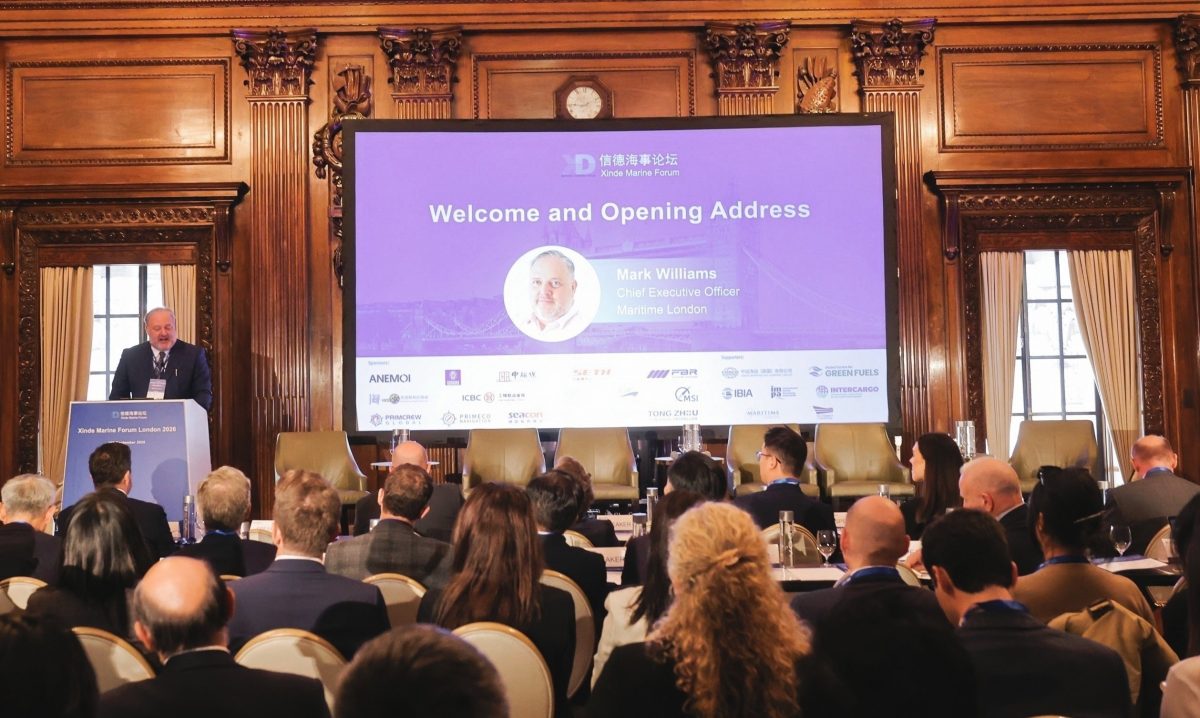
Maritime London’s CEO Mark Williams delivered an opening address at the Xinde Marine Forum held in London this week (16 September), stressing the importance of UK-China relations over shipping matters.
The theme of the event – ‘Shipping in Transition: Resilience, Risk and Repricing’ – “could scarcely be more timely,” he told listeners at the outset of the event organised by China-based publisher Xinde Marine. “Shipping has always lived with risk. But today, risks which we once considered separately have become entangled.
“Geopolitical conflict redirects trade,” he continued. “Trade disruption affects freight markets and supply chains. New regulation changes operating costs and asset values. Decarbonisation requires new fuels, new technology and enormous amounts of capital. Digitalisation and artificial intelligence create remarkable opportunities—but also new operational and security risks.
“Even the apparently simple question ‘What is a ship worth?’ now depends upon increasingly complex assumptions about fuel availability, carbon costs, regulation, technology and trading patterns.”
Williams went on share his belief that such a period of transition “not only is something to be endured [but] also an opportunity to be understood, financed and led,” – which is why London remains so important to global shipping.
“London does not seek to compete with Shanghai, Singapore or Rotterdam in the volume of cargo passing through its ports, or with the great shipowning centres in the number of vessels controlled from the city,’ he explained. “Its strength lies elsewhere.
“Within a mile or two of where we meet today, shipowners and charterers can find brokers, insurers, financiers, lawyers, arbitrators, classification experts, technical advisers, data providers and technology companies. London is also home to the Baltic Exchange, the International Maritime Organization and many of the international bodies which help shipping to operate across borders.
“The IMO, in particular, provides an institutional bridge between London’s commercial maritime cluster and the governance of global shipping.
“This concentration of knowledge is not an historical curiosity. It is a working commercial asset. The maritime business-services sector contributes around £6.7 billion in annual turnover, nearly £3 billion in gross value added, and more than 23,000 highly skilled jobs. The wider UK maritime economy contributes approximately £63 billion and supports more than a million jobs.”
Williams was quick to dismiss any complacency over London always retaining its position, pointing out that other international maritime centres are moving quickly in their development. That is one reason why Maritime London has recently urged UK policymakers to “look closely at the conditions affecting maritime competitiveness: taxation, immigration, regulation, sanctions, talent and education, access to scale-up capital, and the practical effects of policy upon companies deciding where to invest and locate their senior decision-makers,” he said.
UK – China cooperation
But the ‘bigger prize’ at stake for all international centres, Williams continued, is the global maritime transition itself “requiring trillions of dollars of investment. No city, and no country, can achieve that transition alone.”
And here “China’s importance to shipping is apparent,” he averred. “It is central to shipbuilding, trade, ports, manufacturing, finance and increasingly maritime technology.” At the same time, “The United Kingdom brings complementary strengths in finance, insurance, law, professional services, research and regulation,” he pointed out.
“The relationship between our two maritime communities therefore matters—not merely to China and Britain, but to the effective functioning of world trade.
“We will not always approach every question from the same starting point. But shipping has always required practical cooperation across political and national boundaries. A vessel may be built in one country, owned in another, financed in a third, insured in London, crewed internationally and employed in trades spanning the world.
“Shipping is globalisation made physical.
“The discussions today—on geopolitical disruption, resilient supply chains, green shipping, digital transformation, regulation, finance and changing asset values—address different aspects of a single question: How do we give shipping the confidence to invest while the future remains uncertain?
“There will be no single answer,” Williams admitted “But better answers emerge when shipowners, cargo interests, financiers, insurers, technologists, regulators and advisers speak candidly to one another.” That is the purpose of a UK-China forum such as this, Williams concluded.

