

Posted on: 11 June 2026
Maritime London and the British Embassy in Athens held the 9th edition of the Greek-British Shipping Forum at the National Gallery in Greece’s capital on June 2 (see agenda here).
Welcoming the audience, His Majesty’s Ambassador to the Hellenic Republic Matthew Lodge said: “Our shipping partnership goes back many years. As we were powerfully reminded at yesterday’s [Posidonia] opening ceremony, Greek shipping plays a central role in global trade – a role of strategic importance to us all here in Europe. Meanwhile, based on deep experience and global connections, the UK provides world-leading maritime services. Together, we can be a powerful combination of fleet and expertise.”
“Shipping now sits at the sharp edge of geopolitical and economic change.,” he continued. “A range of regional crises and strategic choke points threaten international prosperity. At the same time, we are witnessing growing tensions between the world’s two largest powers, the United States and China. In this evolving landscape, the importance of international cooperation and of clear, consistent global rules has never been greater.
“The United Kingdom is committed to playing a positive and constructive role, working with our partners. The UK brings together a unique set of capabilities. Our maritime services sector remains the most comprehensive in the world; our financial markets are critical to funding change; and our technology companies are at the forefront of developing practical solutions, from alternative fuels to digital optimisation and vessel innovation.”
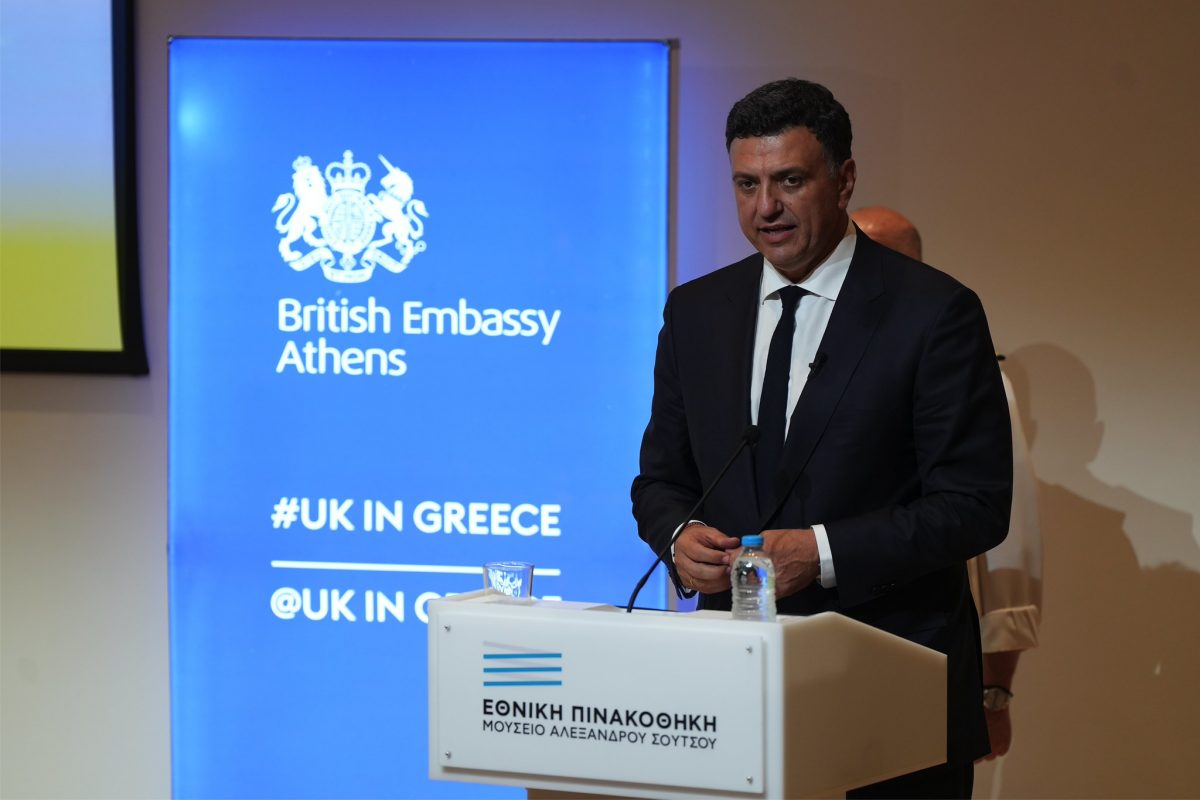
Vassilis Kikilias (pictured), Greece’s Minister of Maritime Affairs and Insular Policy, delivered a keynote address. He said that the Greeks strongly believe in tradition and that the relationship between Greek shipping and London, built over more than a century, is a powerful example. It combines heritage with modern business, resilience and strong cooperation. Greek shipping, despite the country’s small population, remains a global leader, because it was built from the ground up by people with deep ties to the sea and a spirit of determination. The UK was and remains the leader in maritime services. The two create a powerful combined strength.
He also noted that the event was taking place amid rising geopolitical uncertainty, with conflicts disrupting trade routes, shifting energy flows, and increasing pressure on global shipping. At the same time, the industry is facing major challenges from technological change and the urgent need for decarbonisation and sustainability.
The Minister said: “We believe in global peace and trying to solve our differences in the best possible way with dialogues. The importance of shipping is more than obvious in the most dramatic way. If the straits are closed in one part of the globe, you get increasingly high energy prices and the prices of goods everywhere, so it affects every family, a British family, a European family. We all must have a very, very serious conversation about a common agenda.”
After thanking the Minister and the Ambassador, Chair of Maritime London Harry Theochari OBE outlined the seminar’s programme and introduced, Phillippa Charlton, Chief Marketing Officer of Lloyd’s Register, who recently joined Maritime London’s Board of Directors, and Mark Williams, Maritime London’s new CEO, as panel moderators.
Stephen Gordon, Global Head of Clarkson Research, delivered a market outlook presentation, which focused on the green transition and the risks and opportunities created by disruption. Looking ahead, Clarkson Research expects long-term growth for the industry, which will be more complex, influenced by factors such as reshoring, energy security and shifting global trade patterns.
Mr Gordon said that Greece continues to play a leading role in global shipping, controlling a significant share of key sectors and investing actively in fleet modernisation, gas shipping, and efficiency improvements.
In conclusion, he said that geopolitical disruption is currently the primary driver of the shipping market, but the industry remains financially strong and resilient, and while the pace of the green transition has slowed, it remains a central long-term objective supported by ongoing investment in technology and fleet renewal.
Philippa Charlton introduced the first panel “The Stress Test – How decarbonisation technologies perform in the commercial realities of the charter market” and its participants: Kathleen Elward, VP Commercial Operations at Silverstream Technologies, James Scaife, Chief Financial Officer of NatPower Marine, Noel Tomlinson, Business Development – Commercial Shipping & Ports at BMT and Clare Urmston, Chief Executive Officer of Anemoi.
Philippa started her opening remarks saying that the recent IMO MEPC84 meeting delivered limited progress, and while a global net-zero framework remains under discussion, agreement on its current form appears unlikely. In the absence of a unified global solution, regional regulations – such as EU ETS, FuelEU, California’s maritime rules and the upcoming UK ETS expansion – are advancing. These measures are already influencing commercial decisions and increasing compliance requirements. Against this backdrop, industry initiatives, such as the Maritime Emissions Reduction Centre (MERC), which was launched by major Greek shipowners, are accelerating practical action.
The panel discussed available technologies, which range from efficiency upgrades, like hull cleaning, wind assistance and air lubrication, to more complex solutions like onboard carbon capture. Most of these technologies are already technically viable and capable of delivering fuel savings and emissions reductions.
The panellists agreed that the main barrier was commercial, not technical. A key issue is that incentives are misaligned; shipowners typically invest in technology, while charterers pay for fuel and benefit from savings. This creates uncertainty over who captures the value, thus slowing adoption. However, as a result, innovative commercial models are emerging, including cost-sharing mechanisms, performance-based contracts, and charter agreements that better align incentives.
Clare Urmston, CEO of Anemoi, said: “It was a great pleasure to represent Anemoi, given our Greek Heritage at the Greek-British Shipping Forum. Alongside other industry experts, it is important to face into the real day to day challenges that decarbonisation strategies can bring, especially for first movers and those who may be hesitant. Our role is to learn from our customers to continuously improve the technologies, improve ROI to make adoption an easy choice with the ultimate goal to increase fuel and emissions savings to preserve our planet.”
Kathleen Elward, VP Commercial Operations at Silverstream Technologies, said: “Many thanks to Maritime London for facilitating this important discussion and to all the panel participants for sharing insights into how they fit into the wider puzzle.”
“It is clear that, whilst the maritime industry transitions to a more efficient and sustainable future, Silverstream’s air lubrication system provides a verified solution today. With more than 160 systems in the water, we have the scale and expertise to future-proof fleets from day one and will continue to be a powerful way to reduce fuel costs post-alternative fuel adoption,” she added.
The concluding panel ‘How does nuclear power change commercial dynamics in global shipping?’ was moderated by Mark Williams, which included Alfred Butrous, Director, Global Shipping, Logistics & Offshore at Citi, Olivia Haslam, Deputy Director for Ports and Shipping of the UK Department for Transport, Patrick Ryan, Sustainability Director and Head of Club Secretariat, UK P&I Club, who is also chairing the International Group of P&I Clubs’ Nuclear Committee, Mark Tipping, Global Offshore Power 2 X Director at Lloyd’s Register and Baroness Vere, Group Head Market Development at CORE POWER.
The panel agreed that nuclear-powered shipping is moving into a new phase, driven by advances such as small modular reactors, however, it is still facing significant commercial challenges. Previous attempts, in the 60s–90s, were largely unsuccessful due to high costs, technical issues, but also public opposition. Today’s technology is safer and a lot more advanced yet building a viable market for nuclear-powered fleets remains a complex task.
The key commercial shift lies in the cost structure, they highlighted. Nuclear ships require very high upfront capital investment but offer low operating costs, as they do not rely on fuel. This changes shipping from a traditional, volatile business into a more stable, infrastructure-like model, which could attract long-term investors, such as pension funds for example. It may also lead to new ownership models, where operators pay for energy rather than owning the reactor itself.
Public acceptance is a further challenge. Nuclear technology is subject to intense scrutiny, and societal concerns around safety and waste must be addressed transparently. However, growing interest among younger professionals and recognition of nuclear as a low-carbon energy source may support adoption.
In conclusion, the panel agreed that nuclear shipping offers long-term potential, particularly for high-energy, long-distance operations, but its success depends on solving commercial, regulatory, financial, and societal barriers through strong collaboration between industry and governments.
Baroness Vere, Group Head Market Development at CORE POWER, said: “The real question is no longer whether nuclear can work at sea; it is what commercial model will allow it to work at scale. Nuclear propulsion changes the economics of shipping by moving energy from a voyage-by-voyage fuel cost into a long-life strategic asset. That has implications for owners, charterers, insurers, ports, regulators and financiers. CORE POWER is building the partner ecosystem, technology pathways and industrial model required to make ship-based nuclear energy deployable at commercial scale.”
Summarising seminar’s discussions, Evita Souri, Country Manager at the British Embassy in Athens and the UK Department for Business & Trade, said that key takeaways included the transformation of global shipping, the importance of international collaboration, and continued innovation in technology, including nuclear. She thanked the speakers and partners, including Maritime London and Lloyd’s Register, for the ongoing support and contributions, inviting all to enjoy an evening reception.

